Capital Is Not the Flex Anymore. Impact Is.
A preview of a book I've wanted to write for years. Working title: Star Trekonomics.
Origin
The seed of this essay has been rattling around in Daniel's head for years: the Federation as an economy where capital converts to nothing and impact converts to everything. The LLM era finally supplied the mechanism. AI as substrate, not tool. Drafted July 21, 2026 as the public preview of the book.
Star Trek fans will know this about AI.
In the Federation, no one accumulates power through capital. There are no billionaires on the bridge of the Enterprise. Power is derived from making consequential decisions that positively impact the people around you.
You're a science officer. The work you do helps the ship, or teaches someone else to become an engineer.
You're the captain. The work you do furthers research, trade, and diplomatic relations.
You're a security officer. You protect lives and create a feeling of societal safety.
Nobody on that ship asks what anyone else is worth. The question doesn't even parse. Capital has no power in a society where all base needs are met. Unless the computer itself cannot provide that base need.
I've thought about this for years. Long enough that I've been carrying a whole book around in my head, working title and everything: Star Trekonomics.
Someone Already Wrote That Book. Sort Of.
Screech. Manu Saadia published Trekonomics in 2016, and it's good. He took the Federation seriously as an economy. The replicators, the absence of money, the strange fact that Picard's ambitions point at archaeology instead of a yacht. If you like Star Trek and you like economics, read it.
But 2016 was before. Saadia's engine was the replicator, a machine that produces things. He couldn't have written about a machine that produces cognition, because in 2016 that machine didn't exist in any meaningful form. Now it does. And a machine that produces cognition changes the economics far more than a machine that produces things ever could.
So this is not that book. This is a preview of a different one. Saadia asked what the Federation's economy would look like from the inside. I'm asking something closer to home. What happens to capital (to ownership, to the quiet compounding of wealth into power) when intelligence itself stops being scarce?
My answer, which I'll spend the rest of this essay defending, is that capital stops converting into power. Not because anyone votes for it. Because the conversion mechanism itself breaks.
That is a claim about direction, not about this quarter. It runs on a clock measured in decades. And I know how it sounds in 2026, while four companies convert capital into compute at the fastest clip in business history and look, for all the world, like capital's greatest flex ever. The railroad barons looked permanent in 1880 too. Within a generation, rail was a price-regulated commodity and the power had moved on. Maybe this buildout is different. Maybe it's the same movie with better effects. The rest of this essay is my case for the second reading.
One more honest note before the argument starts. The Federation proves nothing. It is fiction, and it was built to make status-from-service feel natural, so leaning on it as evidence would be arguing in a circle. I use it the way engineers use an ideal machine, to feel a mechanism before measuring it. If you want a prestige economy that already runs at planetary scale, look at open source. The infrastructure under most of the internet is maintained by people who are paid, mostly, in being looked up to.
The Analogies Everyone Reaches For
You'll often hear comparisons between this cycle and previous cycles. Railroads. The fiber build-out. The dot-com boom. Oil drilling. The airplane business.
The numbers invite the comparison. Microsoft, Alphabet, Amazon, and Meta guided to more than $300 billion in combined capital expenditures for 2025, most of it AI data centers, and the 2026 plans run somewhere between half a trillion and three quarters of a trillion. The railroad barons of the 1880s spent, by commonly cited estimates, around 6 percent of GDP at the peak of their build-out. That's several times AI's share of the economy today, though the historical accounting is fuzzy enough that I hold the exact percentages loosely.
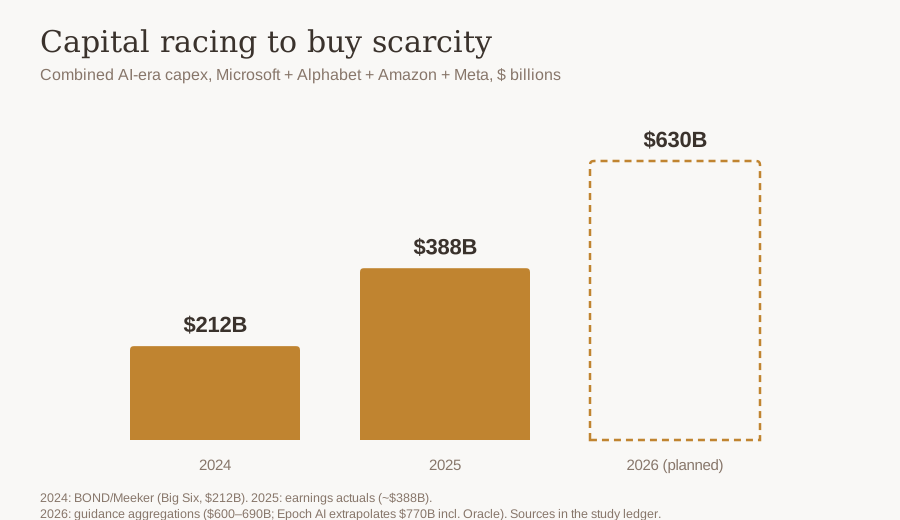 The four biggest buyers of compute, spending like the fence will hold.
And I should name the frame instead of shadowboxing it. Derek Thompson wrote last November that the AI build-out is "on track to exceed every major technology since" the railroads as a share of GDP. Paul Kedrosky told Paul Krugman's readers that a data center full of GPUs is "like a warehouse full of bananas," perishable capital in the tradition of canals and rural electrification. Smart people. Fair renderings of the argument.
But they are measuring the wrong thing. Spend-share tells you how much steel went into the ground. It tells you nothing about what the infrastructure carries.
A railroad moves wheat. A fiber line moves bits. This thing moves decisions.
These comparisons come from people who know cycles better than they know the thing inside this one. They believe AI is a tool. They consistently call it a tool.
 The captain has heard the railroad analogy before.
Substrate, Not Tool
It is not a tool. It is substrate. It is a low hum that exists beneath the surface of everything, and it raises humans one or two levels up within Maslow's hierarchy of needs. Or at least the five billion of us within reach of a connection. The hum has not reached everyone, and I won't pretend it has.
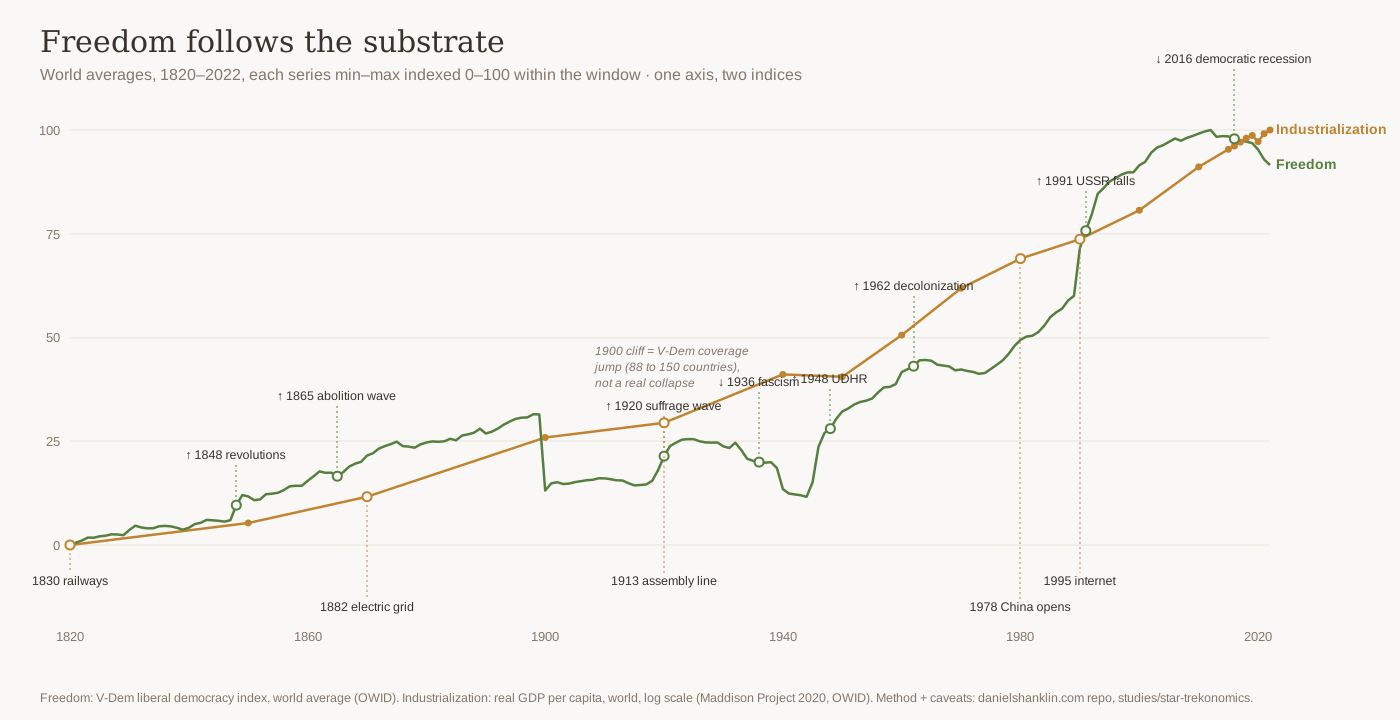 Two centuries of the substrate rising, and freedom stepping up after it.
How to read that chart, and why I trust it only so far. Freedom is V-Dem's liberal democracy index averaged across countries, the longest freedom series that exists. Industrialization is world GDP per person from the Maddison Project, on a log scale because growth compounds. Both are indexed 0 to 100 inside the window so they can share one axis. The freedom line moves in steps (1848, abolition, suffrage, 1948, decolonization, 1991) and the down-steps are real too: fascism in the 1930s, and the democratic recession we are living through since the mid-2010s. The 1900 cliff is bookkeeping, not history. V-Dem's country list jumps from 88 to 150 that year. And two centuries of correlation is not a mechanism. Industrialized autocracies were real and murderous. The honest claim is only this: on average, when the material substrate rises, freedom steps up behind it, and it has never durably stepped back down while the substrate kept rising. Full method, data, and caveats are in the study folder in the repo.
It is not a substrate that can be controlled, either. People are certainly trying. Export controls, closed weights, rate limits, half-trillion-dollar clusters. Cornering a market requires a scarcity you can own, and every one of those is an attempt to manufacture that scarcity. Track was ownable. If I own the only line from Chicago to Omaha, you pay my price or your wheat rots. Oil was ownable. Spectrum was ownable. But intelligence generated from a computer gets cheaper every quarter, leaks through open weights, distills into smaller models, and reproduces at the cost of electricity. The chip embargoes mostly taught the excluded to be efficient. The closed frontier has held its lead for months at a time, never decades. Maybe this fence holds where the others failed. The record says otherwise, and I'm betting with the record. The moat keeps evaporating because the thing in the moat is water.
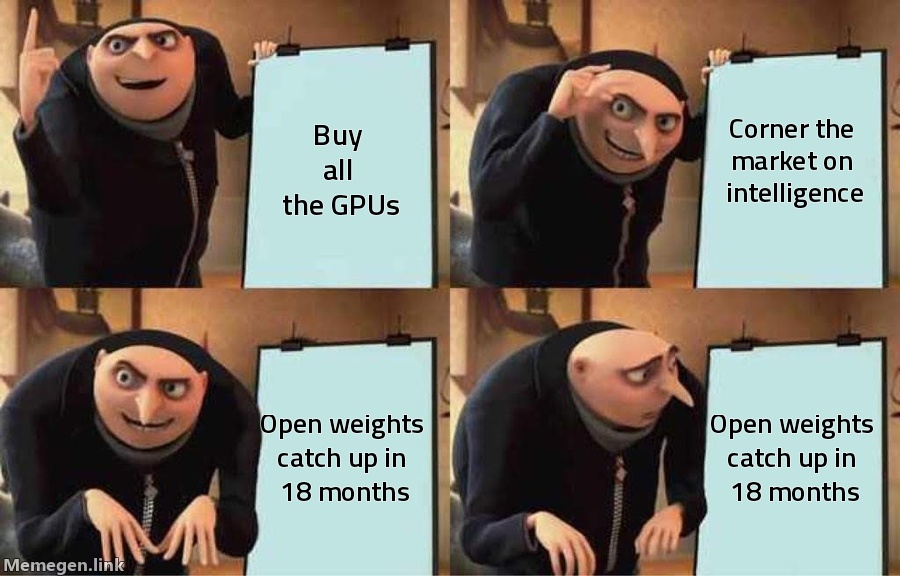 Every corner-the-market plan so far.
The very act of generating intelligence from a computer changes the very nature of trade, negotiation, want, and need. And at the end of that road, capital buys you almost nothing that AI could not provide itself. Today, to be clear, capital still buys the cluster, the exclusive data, the team that aims the model, and the patience to wait out losses. The claim is about where the road ends, not where we stand.
Satiety
It has to do with satiety. The idea that people will only see so much before they stop. And AI provides more than enough. Past a point, people see no reason to quest for much more, even when it might be good for them.
Economists have circled this for fifty years. Richard Easterlin noticed in 1974 that national happiness didn't seem to rise with national income over the long run the way it does in a cross-section. Betsey Stevenson and Justin Wolfers pushed back in 2008 with data showing well-being does keep climbing with income, with no clean satiation point. I won't pretend the academic fight is settled. It isn't, and I'm not going to build the book on a contested regression.
My claim is narrower and, I think, sturdier. It's not that money stops mattering. It's that what money buys you socially keeps migrating. Psychologists call the personal version hedonic adaptation. You get the thing, the thrill fades, the baseline resets. Societies adapt the same way. When everyone has the thing, the thing stops being a signal. And AI is about to make an enormous category of things (answers, plans, expertise, competent work product) as unremarkable as clean tap water.
What happens to a status game when the scoreboard stops registering?
The Flex Migrates
Watch what people brag about. Not what they say they value... what they actually show off.
Start with the weight-loss drugs, because the numbers are stark. In mid-2024, PwC surveyed about 3,000 American consumers and found roughly one in ten adults on a GLP-1. Counted by household, adoption stood at 9 percent in January 2025. Sixteen months later, the May 2026 wave of the same PwC survey put it at 21 percent of households. More than doubled, in under a year and a half. People are working out more, too. And the vacation photo has thoroughly defeated the car photo on your feed, which matches what Van Boven and Gilovich found back in 2003, that experiences beat possessions for happiness, and that most people already sense it.
You could object that the drugs are just a rich person's flex, capital extending its power over bodies. For the first few years, they were exactly that. A four-figure monthly list price is a gate. Then the gate broke. That same May 2026 survey found adoption running flat across income levels, a bottom-bracket household now about as likely to have a user as a top-bracket one, and Fortune's read of the pricing data has the flagship drug's net price down roughly 40 percent since 2017. So a flex that started out capital-gated commoditized inside three years. The old flexes (the watch, the car, the second home) held their gates for generations. That speed difference is this whole essay in miniature.
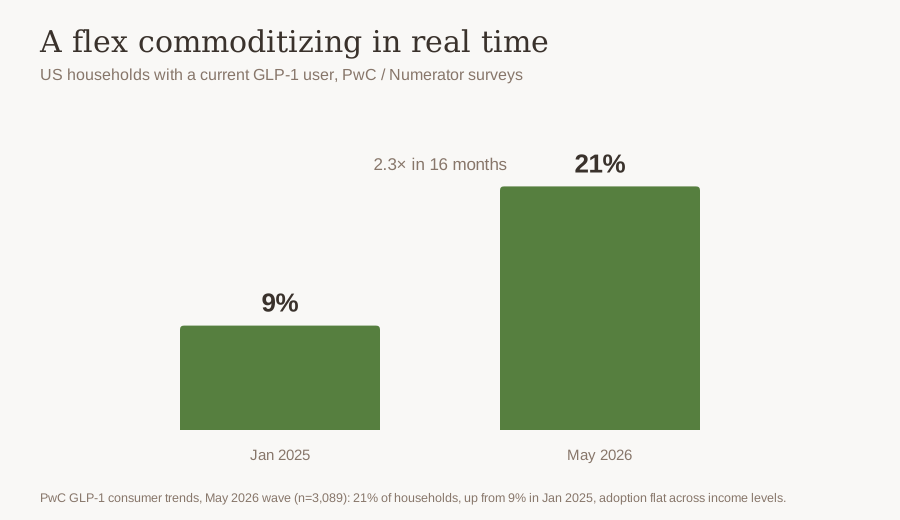 The gate broke fast.
The trip is beating the watch. The "Flex" shifts up a level.
 The scoreboard moved.
Nobody is renouncing wealth here. Ordinary people are just reallocating their status spending, away from things that stopped impressing anyone.
Two Ways to the Top
Anthropologists who study status found something useful here. There are two distinct routes to the top of a human hierarchy, and they run on different fuel.
Joseph Henrich and Francisco Gil-White laid it out in 2001. The first route, dominance, is rank held through force, fear, and control of resources. The second, prestige, is rank conferred freely, by people who choose to defer to you because your skill and knowledge make their lives better. Joey Cheng, Jessica Tracy, and colleagues confirmed in 2013 that both routes genuinely work. Dominance is taken. Prestige is given.
And prestige has the property that matters for economics: it cannot be transferred. You can buy reach, airtime, even applause. The moment the audience smells payment, the deference evaporates. Prestige arrives only through the work itself, witnessed, and it dies with a scandal or a sale. It is the one status good with no secondary market. Yes, prestige still converts into capital today: grants, equity, speaker fees. Notice the direction, though. The money follows the deference. That is the inversion, already visible.
Capital, historically, has been the great dominance battery. It stored coercive potential. The ability to outbid everyone else, to buy the scarce thing and charge rent on it. That's precisely the route AI degrades, because it keeps deleting the scarcities that rent depended on. The two routes will always coexist, the literature is clear on that. My claim is about the mix. Where the substrate reaches and needs get met, dominance loses fuel and prestige doesn't.
Prestige runs on something else entirely. People looking up to you. And people look up to impact, to consequential decisions that made their world better. The science officer. The captain. The security officer.
In the future, capital is not a flex. Impact is. And impact comes from influence, which comes from people looking up to you, which comes from plain old fashioned hard work.
I should say which hard work, because AI prints work product by the ream. Not keystrokes. The kind with a person visibly inside it: responsibility taken, risk carried, care spent on someone else's problem. Respect tracks the spender, not the artifact.
Society will regress to a time when hard work translated into respect. Because it has to. It's the only currency AI can't print.
What Would Prove Me Wrong
I can't claim purity here. I spent my twenties trading billions in complex financial instruments. I ran a company. I hold equity in things I hope compound. If capital truly stops converting into power, I lose a game I've spent decades learning to play. Maybe that's why it took me this long to start writing the book. So watch where my hours go. More of them now go into work I give away, work that earns deference instead of carry, than went there five years ago. Audit me in five years. If the ratio has flipped back, discount the book accordingly.
And the thesis has honest failure modes. Three, at least.
1.) The unless clause. Capital has no power where base needs are met, unless the computer cannot provide the need. Read that unless honestly and the list is long. Housing. Energy. Land. A seat in the right school district. A human hand on your shoulder when it matters. AI prints none of those yet. Whoever owns the substrate under the substrate still collects rent, and the honest version of this book may turn out to be about whether that list shrinks or grows.
2.) Political access. Money buys proximity to rule-makers, and rule-makers can manufacture artificial scarcity faster than AI can dissolve the natural kind.
3.) The frontier itself. If the very best intelligence stays expensive and closed, if the gap between what a billionaire can rent and what you can rent stays wide, then intelligence is still scarce where it counts, and my whole argument stalls.
That's the bet, and you should be able to score it. If the top one percent's share of wealth is still climbing in 2040, if frontier models are holding leads measured in years instead of months, if money still buys the microphone, then I was wrong, and this book becomes a period piece about wishful thinking in the 2020s. I'm taking one side of the bet in public.
But watch the direction of travel. The price of a unit of cognition keeps falling off a cliff. The status games are already migrating. And nobody, not one company, not one country, has managed to fence the hum.
The Book
The working title in my head has always been Star Trekonomics. Saadia owns the pun, and a Trek cover invites the fans while warning off the economists I most want to argue with. So the cover will probably read The Substrate Economy, with the Federation in the subtitle, where it belongs. The title in my head stays, though. Some books you write toward.
The chapters are the sections you just read, grown up and armed with better data. The first table is already drawn: the price of a fixed unit of intelligence, quarter by quarter, set against how long each frontier model keeps its lead over the free copies. Everything downstream of that table is the argument. If the price stops falling, or the leads stretch from months into years, the book loses. The best future arguments are data-driven now, because for the first time, the author has an intelligence substrate to check them against.
So here's my question for you, and I genuinely want the answer. What do you flex now that you didn't ten years ago? And what did you quietly stop flexing... because nobody was impressed anymore?
Tell me in the comments. It's chapter research.